Image:2560.jpg
From ZaInternetHistory
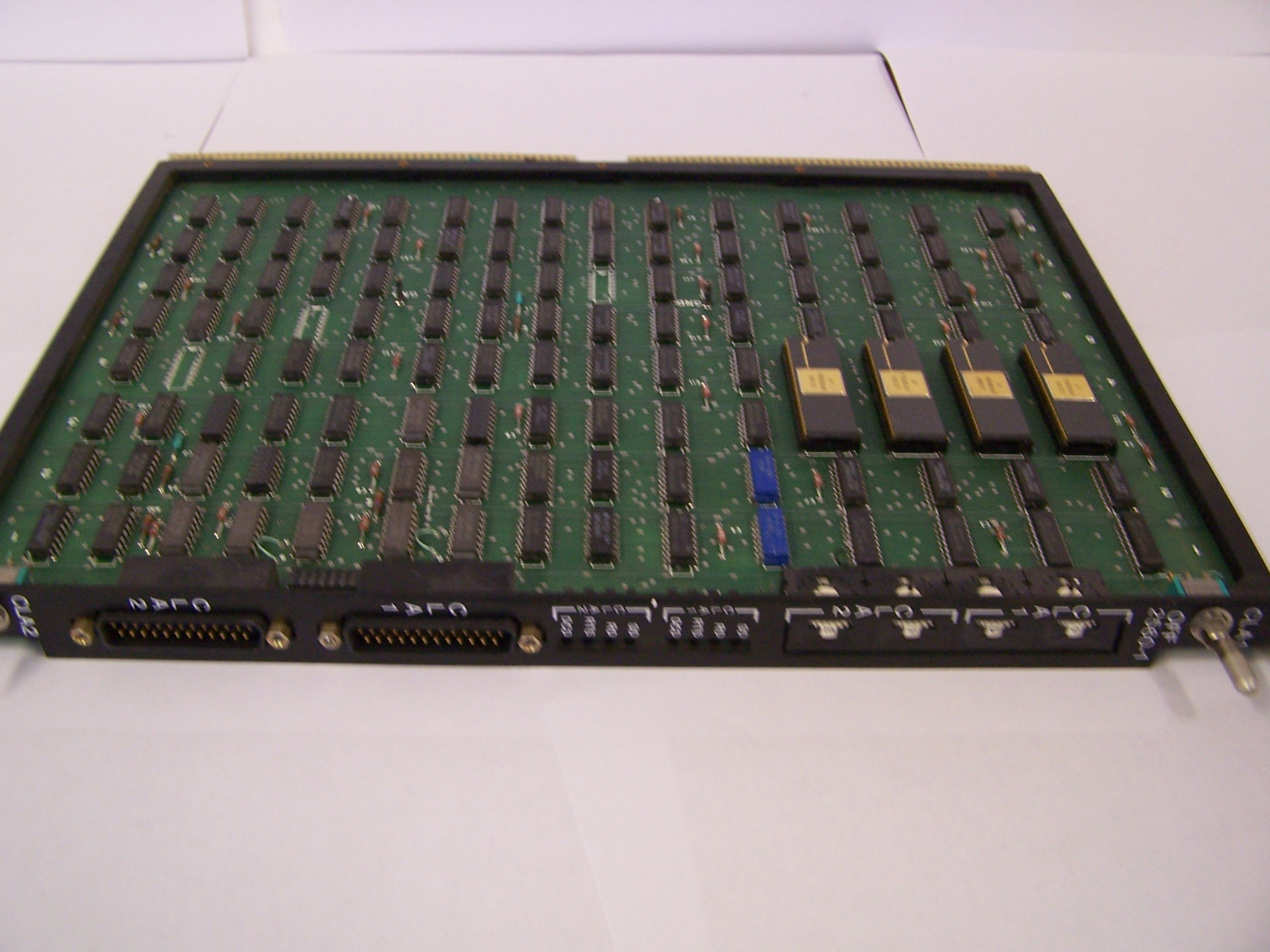
2560 serial card for the Cyber
This is one of the Control Data CLA (communication line adapter) cards from the Cyber 2550 NPU (network processing unit or front end processor, FEP). There were eventually about 48 of the 2560 serial CLA's, giving just under 100 serial ports into the mainframe.
The NPU was a shared peripheral between the two Cybers and was linked to each by means of a channel cable. Ports, or port ranges were configured to be active in one or the other (but not both) systems. So two ports on the same card could be talking to different mainframes.
The majority of connections to the Cyber were dumb terminals, mainly Newburys (which had been used on the ICL) and Tatungs. A few Apple ][ clones had terminal emulation software, and the early IBM pcs also connected up using special CDC terminal emulation software called CDCConnect(?).
The Plato system used Viking 721 terminals, with vector graphics (similar to Tektronix 4014) and touch screens. All in all rather a nice user interface for the early/mid 1980's.
Later on communications on the Cyber was provided by CDCNet hardware, which supported ethernet, TCP/IP, high density serial ports (our first experience of RJ45 connectors and ribbon cable), and X.25 trunks into synchronous ports.
The X.25 trunks formed a convenient method for providing low density terminal clusters in remote locations, and it was possible to link up a Micom X.25 pad with up to 12 terminals connected into it back over a synchronous Diginet line to one of the CCNet units at Rhodes.
There were CDCNet boxes installed at Unitra and at the East London campus of Rhodes. The Unitra box provided a Plato service, while the East London box provided TCP/IP telnet sessions for dumb terminals in East London into RUBIS, the Adds Mentor being run by the Information Systems Department in Grahamstown.
Other remote Plato sites were supported by Case multiplex concentrators, but the down side of these were that you had to have as many upstream serial ports as you had downstream serial ports. The local ports were then connected into ports on the NPU or CDCNet.
X.25 trunking meant that multiple remote serial ports connected into a single local synchronous port. This was much more cost effective, and led to something of a boom in remote Plato networking - All Saints College in Bisho, Trinity High School in P.E., Kingswood and St Andrews in Grahamstown, Unitra, NIPR in Johannesburg and Cape Town, Rowntree in East London, and the Rhodes East London Division. The Plato bulletin board system allowed students at all these institutions to communicate with each other, and to arrange opponents and times for real time "network" games such as Moria and a flight simulator game. "Forums" have a long history at Rhodes.
What brought this whole mainframe era to an end was lack of horsepower on the 825 and the inability to support increasing numbers of users. It didn't make any economic sense to upgrade to the next level of mainframe. A budgetary number from the late 1980s that sticks in the mind was that a CDC 885 disk drive unit (2 x 600 megabyte sealed spindles) cost R100k. IT Steering committee meetings were invariably torrid.
Plato eventually (1993/94?) moved on to locally developed PC based authoring software called CalNet (Computer Aided Learning network) and some of the Plato courseware was converted.
Soon after this, the admin computing moved on to a dual processor Sun SS70 in 1995, which became known as Protea after objections to its original name of Tokolosh. The latest version of Protea, a Sun V880, was installed in 2003.
Image history
Legend: (cur) = this is the current image, (del) = delete
this old version, (rev) = revert to this old version.
Click on date to see image uploaded on that date.
- (del) (cur) 14:50, 1 Sep 2005 . . Guy (593375 bytes) (2560 serial card for the Cyber)
Image links
The following pages link to this image:

